
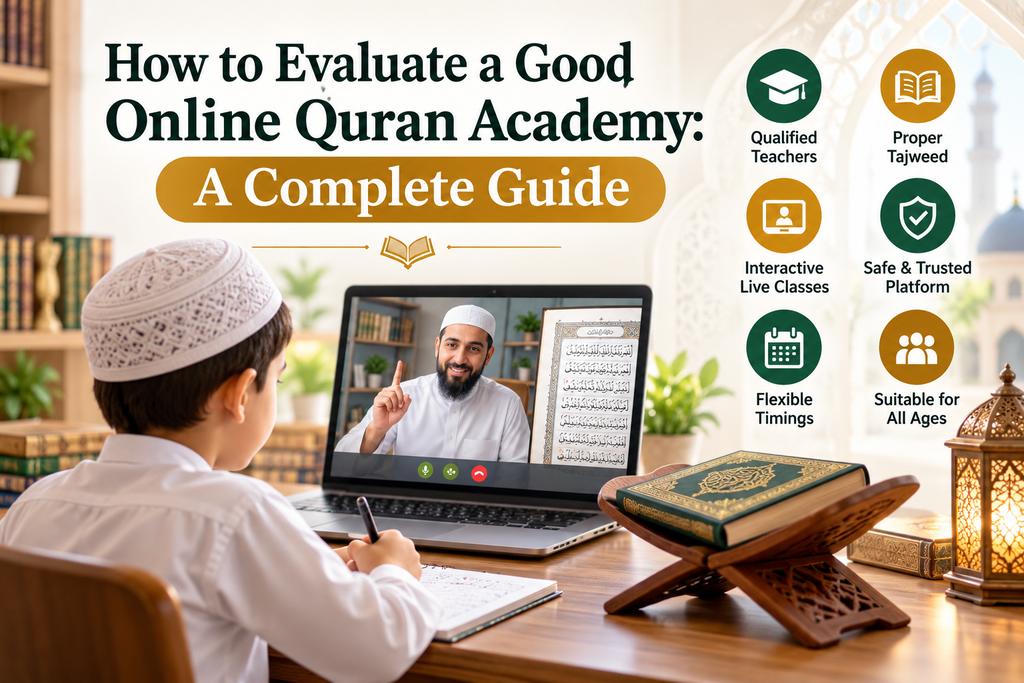
Choosing the right online Quran academy is an important step toward learning the Holy Quran with proper pronunciation and understanding. Whether you’re looking for classes for your children or want to improve your own recitation, finding a trustworthy academy makes a significant difference.
Today, many online Quran academies offer flexible schedules, qualified teachers, and personalized lessons. However, not every institution provides the same educational quality.
Knowing how to evaluate a good online Quran academy helps you avoid unreliable services and choose an institution that genuinely supports your learning goals.
This guide explains the essential factors to consider before enrolling.
What Makes a Good Online Quran Academy?
A reliable online Quran academy combines qualified teachers, structured courses, effective teaching methods, and consistent student support.
The goal shouldn’t be simply completing lessons. Students should develop accurate Quranic pronunciation, confidence, and a strong foundation in Islamic learning.
A quality academy typically provides:
- Experienced male and female Quran teachers.
- Proper Tajweed and Arabic pronunciation instruction.
- Personalized one-on-one learning opportunities.
- Flexible class schedules.
- Regular student progress assessments.
- Clear tuition fees and attendance policies.
- A supportive and respectful learning environment.
These features help students progress according to their abilities rather than following an unsuitable learning pace.
Check the Qualifications of Quran Teachers
The teacher’s knowledge and experience should be your first consideration.
A qualified Quran teacher understands Tajweed rules, Arabic letter pronunciation, and appropriate teaching techniques.
Look for Relevant Islamic Qualifications
Teachers may hold qualifications from recognized Islamic institutions or have completed specialized Quranic studies.
For advanced recitation courses, an Ijazah can demonstrate authorization in a particular Quranic recitation tradition.
However, teaching beginners doesn’t always require an Ijazah. Accurate recitation, appropriate knowledge, and effective teaching skills remain essential.
Evaluate Teaching Experience
An experienced teacher knows how to explain difficult concepts patiently.
For example, a young beginner learning Noorani Qaida requires a different approach from an adult studying advanced Tajweed.
During introductory classes, observe whether the teacher adjusts explanations to the student’s learning level.
Evaluate Tajweed and Quran Recitation Standards
Tajweed helps students pronounce Quranic letters correctly and apply established recitation rules.
A good academy shouldn’t focus only on completing pages. Teachers must identify pronunciation errors and explain how students can correct them.
Important Tajweed topics include:
| Tajweed topic | Learning objective |
| Makharij al-Huruf | Correct Arabic letter articulation |
| Madd | Proper vowel elongation |
| Ghunnah | Correct nasalization |
| Qalqalah | Proper articulation of specified consonants |
| Waqf | Appropriate stopping during recitation |
Personalized correction is especially important. Listening to recordings alone cannot replace direct feedback from a knowledgeable teacher.
Review the Quran Courses and Curriculum
A structured curriculum helps students progress from basic reading to more advanced Quranic learning.
Before enrolling, ask whether the academy assesses each student’s existing knowledge.
Common online Quran courses include:
- Noorani Qaida: Arabic letters and foundational reading skills.
- Quran Reading: Developing fluency and accuracy.
- Quran With Tajweed: Applying proper recitation rules.
- Quran Memorization: Structured Hifz and revision.
- Quran Translation: Understanding Quranic meanings.
- Islamic Studies: Learning essential beliefs, worship, and manners.
The academy should explain what students will learn and how their progress will be measured.
Look for One-on-One Quran Classes
Individual Quran lessons can be particularly beneficial for beginners and children.
With one-on-one teaching, students receive dedicated attention and more opportunities to recite.
Key benefits include:
- Personalized lesson plans.
- Immediate pronunciation correction.
- Learning at a comfortable pace.
- Greater interaction with the teacher.
- Focused memorization and revision.
Group classes can also work well, especially when students have similar learning levels. However, smaller groups generally allow more individual participation.
Take Advantage of Free Trial Quran Classes
Trial classes offer a practical way to evaluate an academy before committing to monthly tuition.
Some institutions offer free introductory lessons while others charge a trial fee.
During the trial, consider these questions:
- Does the teacher explain lessons clearly?
- Is the teacher patient and respectful?
- Does the student receive individual attention?
- Are pronunciation mistakes corrected?
- Does the class begin on time?
- Is the student comfortable participating?
For children, parental observation can provide additional reassurance.
A successful trial class doesn’t guarantee long-term quality, but it offers valuable insight into teaching standards.
Check Flexible Scheduling and Makeup Class Policies
Online Quran education should fit your daily routine.
Families living in the USA, UK, Canada, Australia, and other countries often need lessons outside traditional school hours.
Before registering, confirm the available time slots and whether they match your local time zone.
Also ask about cancellations, teacher absences, and makeup classes.
Consistent scheduling supports better learning habits, especially for younger students and those memorizing the Quran.
Review Student Safety and Parent Communication
Student safety is particularly important when arranging online classes for children.
A trustworthy academy should maintain professional communication and clear expectations for teacher conduct.
Parents should check whether the academy:
- Verifies teacher identities and relevant qualifications.
- Provides accessible administrative support.
- Allows appropriate parental supervision.
- Explains its child protection procedures.
- Protects student information and lesson recordings.
- Provides a clear way to report concerns.
Regular parent communication also helps identify learning difficulties early.
Compare Fees and Evaluate Overall Value
Affordable tuition matters, but price alone shouldn’t determine your choice.
Compare lesson duration, teacher qualifications, individual attention, and included services.
For example, an academy offering twelve personalized lessons may provide better value than one offering eight lessons at a similar monthly price.
Before paying, request written information about:
- Monthly fees.
- Lesson duration and frequency.
- Payment deadlines.
- Refund policies.
- Makeup class arrangements.
- Additional charges.
Clear policies help prevent misunderstandings.
Check Student Reviews and Progress Reports
Reviews can reveal how an academy performs beyond its advertising.
Look for detailed feedback about teacher punctuality, pronunciation improvements, and administrative support.
However, don’t depend entirely on testimonials published on the academy’s website.
Ask how the institution monitors student progress.
A useful progress report should explain reading accuracy, Tajweed improvement, memorization progress, attendance, and areas requiring practice.
Online Quran Academy Evaluation Checklist
Use this quick checklist before making your decision.
| Evaluation factor | What to check |
| Teacher qualifications | Relevant Quranic education and teaching skills |
| Tajweed instruction | Accurate pronunciation and individual correction |
| Curriculum | Clear courses and learning objectives |
| Trial classes | Opportunity to observe teaching quality |
| Scheduling | Suitable class times and makeup policies |
| Student safety | Professional conduct and privacy measures |
| Fees | Transparent pricing and payment conditions |
| Progress tracking | Regular assessments and feedback |
An academy that performs well across these areas is more likely to provide a dependable learning experience.
Frequently Asked Questions
Q1: How Do I Know if an Online Quran Academy Is Good?
Check its teachers’ qualifications, Tajweed standards, course structure, trial lessons, and student support. A good academy should also provide transparent fees and regular learning assessments.
Q2: Are Online Quran Classes Effective for Children?
Yes. Online classes can help children develop Quran reading skills when teachers use age-appropriate instruction, correct mistakes patiently, and encourage consistent practice.
Q3: Is One-on-One Quran Learning Better?
Individual lessons provide personalized attention and immediate correction. They’re especially helpful for beginners, although well-organized group classes can also be effective.
Q4: Can Adults Learn Quran Online From Scratch?
Absolutely. Adults can begin with Arabic letters and Noorani Qaida before progressing toward fluent Quran reading and Tajweed.
Conclusion
Understanding how to evaluate a good online Quran academy allows you to make a confident, informed decision.
Prioritize qualified teachers, accurate Tajweed instruction, structured lessons, student safety, and clear communication.
Most importantly, attend a trial class and observe the teaching experience before enrolling.
The right Quran academy should do more than provide lessons. It should help you or your children develop accurate recitation, consistent learning habits, and a meaningful connection with the Holy Quran.